Textile Waste for Circular Furniture Design
- Prashant Lingam

- Jan 30
- 2 min read
Updated: Jan 31
Exploring discarded sarees as material systems for small-scale furniture production.

Context
A significant amount of post-industrial and post-consumer textile waste is produced every year in India, and some of this waste is in the form of used sarees that are structurally sound but no longer culturally, aesthetically, or economically relevant. On the other hand, the furniture industry catering to the mainstream market is still dependent on virgin materials or synthetic substitutes. This project was born out of an inquiry into the possibility of using textile waste along with traditional bio-based cane structural elements to produce functional furniture pieces through traditional hand skills creating pathway for livelihood generation and understanding textile and Bio-Materials in Circular Furniture.
Material & System

The core material system integrated discarded cotton and blended sarees converted as ropes and merged with cane structural frames. Cane was chosen because of its known use in lightweight furniture, availability of skilled labor, and natural flexibility. Sarees were investigated not merely as a surface material for upholstery but as a load-bearing and shape-giving component through the processes of wrapping, weaving, knotting, and tensioning on cane frames. The system was based on manual techniques and did not use chemical binders, foams, or synthetic resins, placing the material logic in a low-energy, repairable, and locally executable domain.
Process
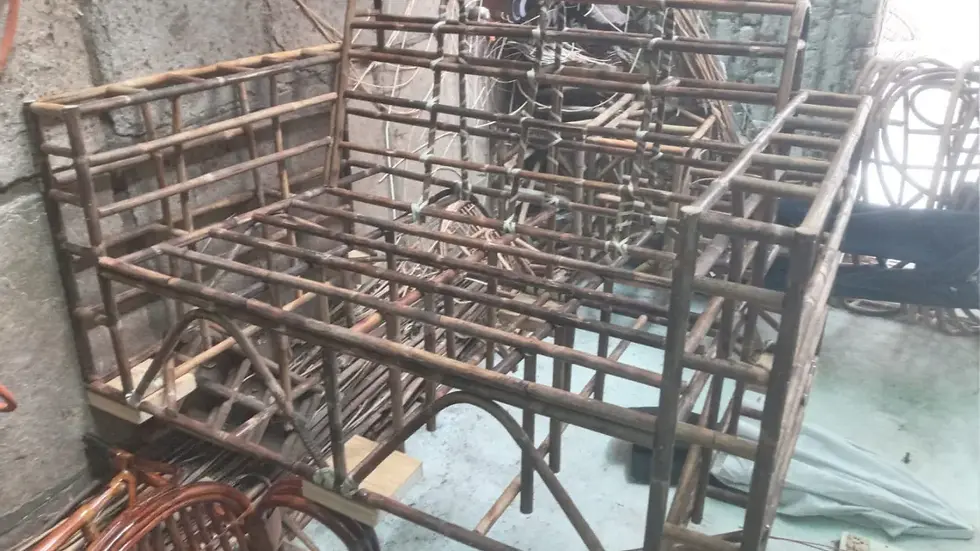
The discarded sarees were obtained from waste streams, scavengers, and donation networks. The materials were categorized according to their strength, weave, and usage. A manual machine was designed to weave sarees into ropes. Cane structures were made by traditional bending and binding, and then layers of textile were added gradually. Various techniques were employed for joining, such as continuous binding, stitched panels, braided strings, and layered tension surfaces. This project demanded intense collaboration with craftsmen experienced in cane furniture but not in integrating textiles at a structural level. The project progressed slowly, as the characteristics of the sarees differed considerably, and the repeatability was limited by the variability in the quality of waste inputs.
Outcome
Functional prototypes were created, including stools, lounge chairs, and low seating units. Although the material system showed promise in the areas of comfort, differentiation, and material recovery, issues arose regarding durability, ease of cleaning, and standardization. The products functioned well in controlled environments but deteriorated more quickly when subjected to heavy or uneven loads. Market feedback was mixed, with praise for the idea but concerns about maintenance and value.

Learning
This particular project has emphasized that textile waste, when considered as a structural participant rather than a decorative material, introduces variability that cannot be standardized. The combination of textile waste and bio-based frames is possible on a small scale but with the acceptance that material variability is a design parameter rather than an error. This project has also emphasized that circular furniture systems, which are based on waste materials, require slower production times, expertise, and markets that are ready to accept variability rather than sameness.
Prashant Lingam
Practitioner - Bio & Circular Materials


Comments