Livelihood Systems within Women’s Correctional Institutions
- Prashant Lingam

- Feb 22
- 3 min read
Updated: Mar 8
Designing Skill Training and Production Workflows Using Circular Material Inputs under Custodial Constraints - Project in Partnership with Department of Prisons - Government of Telangana

This field diary documents the design and implementation of a circular-material livelihood system within women’s correctional institutions in Telangana, undertaken in coordination with the Government of Telangana and the Department of Prisons. The objective was to test whether structured production workflows could function inside custodial systems without compromising institutional discipline.
This was the first such engagement for the entire team. The learning curve was not limited to the inmates; it applied equally to trainers, coordinators, and programme planners.
Time as a Structural Limitation
Inmates could not be engaged full-time. The workable engagement window averaged 3–4 hours per day. This extended training timelines significantly. Production assumptions based on standard eight-hour industrial cycles proved unrealistic. Batch planning had to be recalibrated repeatedly.
Internal Planning Challenges
As this was the team’s first custodial intervention, product planning and curriculum sequencing required mid-course correction. Initial assumptions underestimated:
The emotional variability of participants
Security-induced delays
Skill retention gaps between sessions
Designing the right training mix required experimentation. Circular-material craft alone did not sustain uniform engagement. Introducing parallel modules such as bangle-making and tote bag fabrication improved participation levels.
The team had to shift from a linear training plan to an adaptive model. Curriculum sequencing became responsive rather than fixed.
Textile Waste Craft Systems

Textile waste offered a low-risk starting point. Sorting, strip cutting, rope formation, coiling, and stitching were introduced in modular steps. However, skill speed varied widely. Task segmentation improved efficiency. Even then, participant transfers disrupted continuity. Each product was redesigned to allow handover between batches without compromising quality.
Plastic Waste Craft Systems
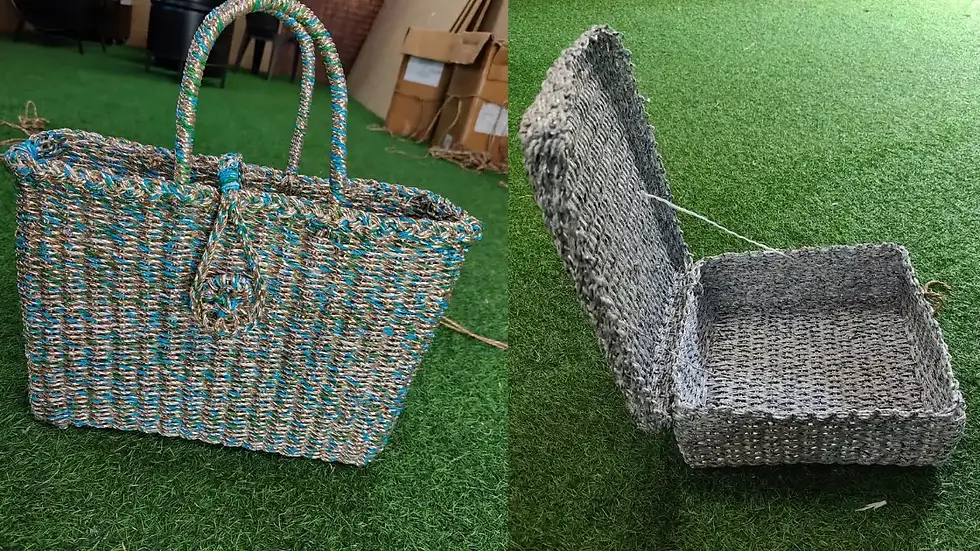
Plastic weaving revealed ergonomic challenges. Women reported hand strain and burning sensations during prolonged weaving sessions. Adjustments included:
Reducing strip width
Selecting softer material
Introducing staggered work cycles
Despite these changes, occasional lack of interest was observed. Engagement levels fluctuated depending on psychological state and institutional climate.
Sabai Grass Craft Systems

Sabai grass introduced moisture-control complexity. Improper soaking affected fiber strength. A monitored soak-and-use protocol was implemented.
A structural limitation emerged: absence of women trainers. While protocols were maintained, early hesitation in interaction highlighted the importance of gender-aligned training teams for custodial programmes.
Security and Entry Protocols

Security schedules frequently extended waiting time at the entrance gate. Material inspection and tool verification reduced effective working hours. These processes are integral to custodial systems but require incorporation into realistic production planning.
Trainer apprehension also surfaced.
For some team members, entering a correctional facility for the first time required adjustment. Building internal team confidence was as important as training inmates.
Pricing and Costing Logic
A pricing model was structured assuming scale. Wages were aligned with departmental guidelines. Product costing incorporated:
Raw material
Institutional wage structures
Training overhead
Quality control
Packaging
However, irregular production volumes made scaling projections unstable. The business model required conservative assumptions rather than aggressive output forecasting.
Interest-Driven Craft Inclusion
Midway through the programme, participants requested training in bangle-making and tote bags. These were introduced.
The response was immediate. Engagement improved. Completion cycles were shorter. Visible output within shorter time frames increased morale.
This adjustment revealed that training design under custodial constraints must balance production logic with interest-driven participation.
Exhibition and Public Interface
The programme concluded with an exhibition conducted by the Department of Prisons. The women’s work was displayed publicly. This external validation reframed the activity from institutional engagement to legitimate production.
For the team, this marked a closure point with measurable output and public acknowledgement.
System-Level Learning
This intervention clarified multiple structural insights:
Circular materials are compatible with custodial production systems.
Time constraints fundamentally shape skill absorption.
Trainer composition influences comfort and participation.
Emotional variability affects production continuity.
Pricing models must reflect institutional wage structures.
Adaptive curriculum design is necessary in custodial environments.
For the team, the project established a new understanding of how to design livelihood training under custodial constraints—what works, what stalls, and what requires systemic redesign before scale can be considered.
Livelihood systems within correctional institutions are viable when built around constraint, not aspiration.


Comments