Hurdles of Scaling Bamboo Housing in India
- Prashant Lingam

- Jan 28
- 7 min read
Updated: Feb 22
Material, Labor, Production, and Market Constraints Observed in Practice
1. Context and Entry Point
Engagement with bamboo housing in India was informed by exposure to Colombian architectural systems and an inquiry into whether similar structural approaches could be adapted to the Indian context. Particular attention was directed toward the bamboo species Guadua angustifolia, noted for its diameter range of 5–10 cm and heights reaching up to 60 feet. Its structural properties—culm thickness, uniformity, and load-bearing potential—provided a reference point for examining bamboo as a primary construction material rather than a temporary substitute.
Bamboo appeared repeatedly across rural construction, temporary shelters, disaster response, and informal housing in India. However, it was consistently positioned as housing for economically weaker sections. At the same time, government policy documents framed bamboo as a sustainable material with significant market potential (Indian Planning Commission Report, 2004 – ₹26,000 crores), without adequately examining the structural, institutional, and market barriers that limited its scale despite decades of advocacy.
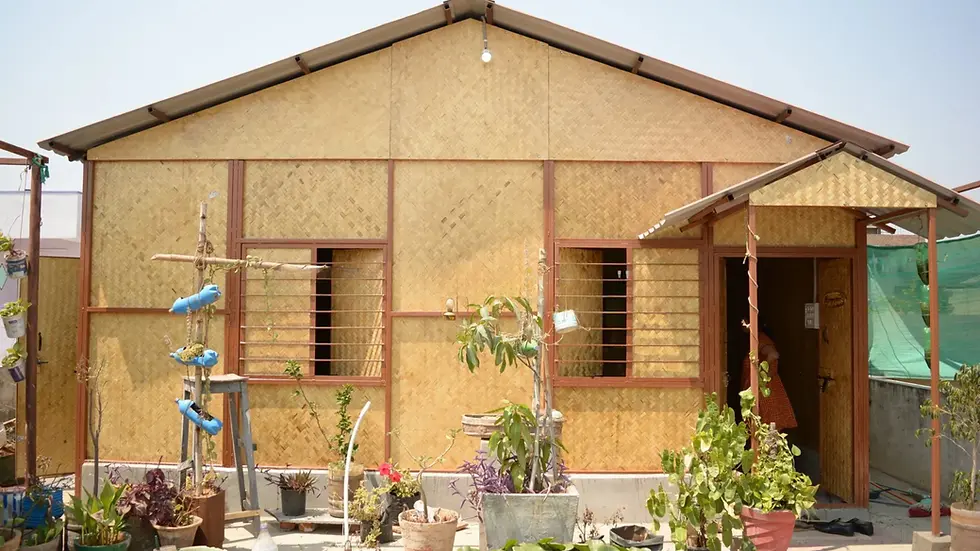
The work presented here emerges from this contradiction. Bamboo is neither unfamiliar to India nor inherently unviable as a natural building material. The critical question concerns why it has remained confined to pilot projects, demonstrations, and isolated interventions. This document draws from two decades of field practice across multiple locations in India, involving the construction of close to 100 complete bamboo structures, with a focus on moving bamboo housing from one-off builds toward repeatable systems. It does not examine engineered bamboo housing systems that rely on bamboo plywood composites or metal frame membrane hybrids.

Structural Component Made using Bambusa Balcoa Species
2. Problem Framing
It would be inaccurate to suggest that raw material is not a constraint. It is. Among various bio-materials used in construction, bamboo has proven to be one of the most complex natural building materials. Its hollow structure traps air and moisture within internodes, and its circular geometry complicates joinery, connections, and finishing. These material characteristics introduce durability, treatment, and performance challenges that are often underestimated in design discussions.
A second structural constraint lies in the ecosystem surrounding bamboo in India. A significant proportion of quality bamboo is located in high-terrain regions, with North-East India accounting for nearly 55% of national reserves, followed by Madhya Pradesh. Policy discourse has largely emphasized design innovation and livelihood potential, while comparatively limited attention has been given to questions of consistent availability, grading, and distribution. On ground, constraints have been institutional, logistical, operational, behavioral, and skill-related, interacting in ways that directly affect implementation.
Bamboo housing encountered multiple simultaneous bottlenecks: the absence of across-the-counter availability of treated, matured structural bamboo; shortage of trained construction workers capable of building with bamboo at scale; regulatory ambiguity despite policy reforms; relatively high end-product costs; lack of formal building codes or technical guidelines; fragmented supply chains, including seasonal harvesting restrictions; and persistent market perception of bamboo as an inferior material. Mainstream construction systems in India are optimised for brick, cement, steel, and concrete. Bamboo does not operate within these established defaults.
Consequently, bamboo housing projects have repeatedly been treated as stand-alone experiments rather than components of a standardized system. Costs have not reduced through repetition; per-square-foot construction costs have tended to rise. While field experience improved problem-handling capacity, structural constraints did not diminish proportionately. Knowledge remained insufficiently institutionalized, scalability remained aspirational rather than operational, and market expansion was constrained by the absence of system-level integration.

3. Process and Method
This document profiles work across varied bamboo housing contexts, including temporary shelters, gazebos, mezzanine structures, semi-permanent structures, and modular housing concepts. The emphasis was not on inventing new structural typologies, but on identifying systemic breakdowns that occurred when projects were repeated, expanded, or transported across geographies.
The first layer of inquiry concerned material sourcing. Reliable access to good-quality bamboo remains a constraint in India, and supply-chain patterns are largely undocumented. Initial procurement involved the species Bambusa balcooa from Tripura, facilitated through local community networks. Only the bottom 10-foot root portion was specified, even at a higher cost, to avoid tapering and wall-thickness reduction common in upper sections. The objective was to secure a wall thickness of approximately 1–2 inches at the tenth foot. Lengths beyond this threshold introduced higher hollowness and increased susceptibility to cracking during long-distance transport, particularly under humid, enclosed trucking conditions. Over a 2,900 km transit, upper sections demonstrated structural vulnerability under sustained vibration and pressure.
The second layer involved treatment protocols. At present, pressure-treatment facilities using Copper Chrome Boric Acid (CCB) are available in India. Earlier, treatment relied predominantly on boric–borax immersion methods, where outcomes were inconsistent. Instances of frass—evidence of powder-post beetle infestation—were observed in inadequately treated poles. Untreated bamboo may contain 0.7% to 8.5% starch, depending on species and maturity, making it susceptible to larvae attack. Subsequently, sourcing shifted toward other North-Eastern regions and geographically closer locations. For example, Hyderabad to Tripura involves approximately 2,900 km of transit, whereas sourcing from Assam reduces this distance to roughly 2,500 km. Under comparable transport conditions, a batch of 100 poles from Tripura recorded a 15% cracking rate, while Assam poles showed approximately 5%, indicating material and transport-related performance differences.
The third layer addressed construction processes, including design and fabrication. Bamboo housing relies on skilled craftsmanship. While traditional artisans possess basketry skills, structural construction requires different competencies: machine usage, load-bearing joinery, modular assembly logic, and factory-to-site knock-down systems. Skill development proved slow, and knowledge transfer was inconsistent. Unlike brick-and-concrete construction, bamboo workflows could not be easily decomposed into unskilled labour sequences.
The fourth layer involved formal regulatory systems. Municipal approvals lacked clarity, and local authorities did not possess reference frameworks for bamboo housing. In the absence of codified guidelines, each project was treated as a standalone case. Professionals trained in conventional construction systems—engineers, architects, contractors—were often hesitant to assume responsibility for bamboo structures without institutional backing or established codes.
The final layer concerned cost determination. Establishing a stable costing framework for bamboo housing remained difficult. Each structure was achievable, but execution required disproportionately high coordination, oversight, and troubleshooting. Scaling would require systematic reduction in effort per unit; existing material, regulatory, and skill ecosystems did not enable that transition.
4. Decisions, Trade-offs, and Constraints
Several deliberate decisions shaped this work. Bamboo housing was not positioned as a universal replacement for conventional construction. In the absence of formal building codes and regulatory clarity, projects were limited to smaller, single-storey structures. This framing generated resistance, as market narratives often demand scalability and parity with concrete systems. However, the objective was to operate within practical and defensible limits rather than extend claims beyond regulatory feasibility.
Pricing introduced a further constraint. Detailed costing exercises indicated an approximate construction cost of ₹1,500 per sq ft. With a modest margin, the quoted price was fixed at ₹2,000 per sq ft. Market response was limited. Labor constituted a substantial component: skilled artisans were paid approximately ₹1,500 per day, and a team of at least four artisans was required to construct a 250 sq ft unit over roughly 30 days. Bamboo construction does not permit substitution with unskilled labor, as structural joinery and fabrication require specialized competence. Consequently, cost compression toward the “low-cost” expectations typically associated with grass-based materials was structurally unattainable.
Wastage calculations introduced additional complexity. Losses occurred through transit damage, treatment inconsistencies, dimensional variation, and cracking. In practice, a flat 5% of total project cost was provisionally allocated toward wastage, although precise quantification remained difficult.
This pricing structure disrupted the prevailing perception of bamboo as a low-cost alternative. It also raised a critical contradiction: transporting raw bamboo over long distances increased embodied carbon. Estimated emissions for a full long-haul transport cycle ranged between 1.6 to 2.2 metric tons of CO₂, challenging simplified assumptions of bamboo housing as inherently eco-efficient at commercial scale. While environmental claims may hold under controlled or localized conditions, long-distance procurement complicates lifecycle assessments in real market scenarios.
Labour continuity further constrained scale. Skilled bamboo workers frequently moved between regions and projects, making team retention difficult. Individual projects were insufficient to institutionalize production stability. Transitioning artisans from hand-tool-based weaving traditions to mechanically assisted fabrication and load-bearing structural assembly required sustained training. Operating precision tools, understanding structural spans, and executing repeatable joinery systems represented a significant shift from traditional craft practices, and this transition proved slow and uneven.

5. Outcomes and Observations
The primary outcome is not a scalable housing model, but clarity on why scaling fails. Bamboo housing in India is not limited by material strength or design imagination. It is limited by unstructured systems, the absence of an organized body of knowledge, the lack of a single agency responsible for knowledge transfer, and the ready availability of raw material.
Where bamboo housing worked, it did so under specific conditions: deep domain knowledge gained after years of failure, strong supply networks close to the point of harvest, trained teams, the ability to absorb financial losses, a social business model format, passion and patient timelines, a conducive market, and buyers willing to pay a higher price. Where any one of these was absent, projects stalled or reverted to conventional materials.
Another observation was that scale did not always mean replication. Some contexts supported clustered deployment, while others required adaptation. Treating scale purely as numerical expansion proved misleading. Bamboo and scale do not go hand in hand; in fact, bio-materials in their original form cannot be scaled in the same way and should not be forced into conventional scale-based business models.

6. Reflection From Practice
Over time, the inquiry shifted from asking how bamboo housing could scale universally to examining where scaling should not be imposed. The assumption that every material must conform to the logic of industrial construction—standardization, speed, uniformity, and cost compression—proved conceptually inadequate when applied to bamboo.
Bamboo housing requires specific preconditions: deep material knowledge, regulatory recognition, a stable pool of trained structural workers, localized access to mature and treated raw material, streamlined inter-state movement without tax or transit barriers, factory-mode fabrication of components, knock-down assembly systems, longer construction timelines, and markets that recognize structural bamboo as legitimate infrastructure. In the absence of these conditions, bamboo is perceived as inefficient or unreliable, rather than being evaluated within its own material and ecological logic.
The experience reinforces that scaling is not solely a technical milestone. It depends on alignment between material behaviour, labour ecosystems, institutional frameworks, supply chains, and social acceptance. When these alignments are absent, attempts at scale remain episodic.
Bamboo did not inherently fail to scale. The surrounding systems—regulatory, economic, logistical, and perceptual—were not structured to accommodate it.
Prashant Lingam
Practitioner - Bio & Circular Materials


Comments